 EN
EN

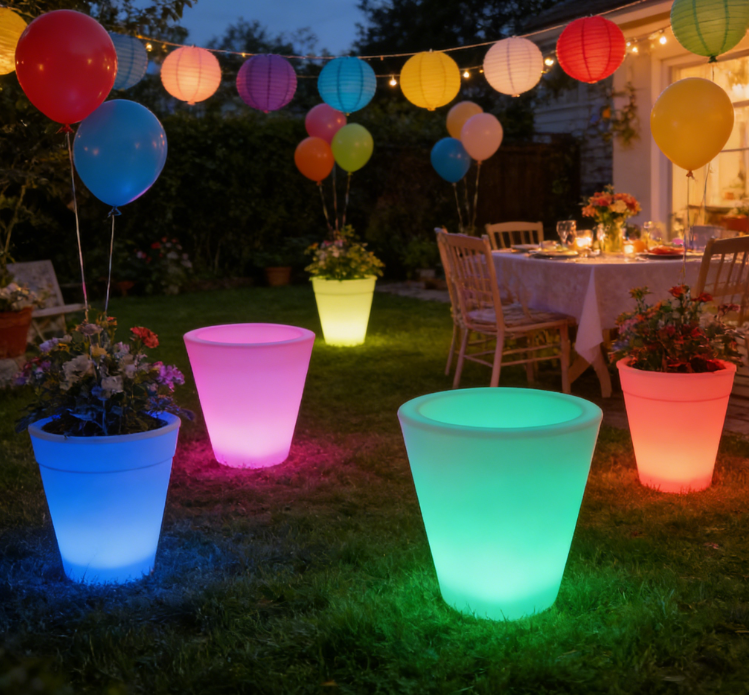
Redefining Spatial Experience with LED Planters
Perceptual Impact: How embedded lighting reshapes scale, boundary, and transition in plazas and courtyards
Embedded LED lighting transforms spatial perception in landscape architecture by turning static planters into dynamic spatial organizers. Strategically integrated within architectural planters, these systems visually expand compact courtyards through layered illumination, soften boundaries without physical barriers—using gentle glows to define walkways while preserving open sightlines—and guide intuitive movement between zones via gradient lighting. This approach supports human circadian rhythms while increasing perceived safety by 47% after dusk, according to the Urban Lighting Institute (2023).
Dual-Role Design Principle: Structural container + integrated light source for functional zoning and emotional resonance
Modern LED planters embody a unified design philosophy: the planter is both horticultural vessel and atmospheric instrument. Its structure houses vegetation while its integrated LEDs deliver targeted, programmable illumination. This dual function enables precise functional zoning—warmer color temperatures (2700K–3000K) anchor social gathering areas, while cooler tones (4000K–5000K) clarify circulation paths. Emotionally, the interplay of organic form and calibrated light triggers biophilic responses, increasing visitor dwell time by 32% in commercial landscapes. Achieving this synergy requires three critical integrations: moisture-sealed electrical components, root-safe thermal management, and adaptive intensity controls that respond to seasonal growth cycles.
Technical Integration and Lighting Strategy for Architectural Planters
Factory-Integrated LED Systems: IP68-rated modules, thermal management, and seamless aesthetics
Optimal performance begins at manufacture: LED systems are fully integrated during fabrication—not retrofitted—ensuring reliability and visual cohesion. IP68-rated modules withstand permanent submersion, essential for irrigation exposure and outdoor weathering. Aluminum heat sinks and passive convection channels maintain stable diode temperatures, supporting lifespans exceeding 50,000 hours. Sealed diffusers prevent moisture ingress while delivering uniform light distribution across planting surfaces—eliminating visible wiring, external fixtures, or aesthetic compromise.
Layered Lighting Hierarchy: Ambient wash, accent uplighting, and human- and plant-responsive color tuning
A robust lighting strategy operates across three coordinated layers:
- Ambient wash delivers foundational visibility (100–200 lux) for safe navigation across pathways and gathering zones
- Accent uplighting, typically with 30° beam angles, draws attention to architectural features or specimen plants
- Adaptive color tuning leverages tunable white (3000K–5000K) and horticulturally optimized spectra (e.g., 450nm blue and 660nm red wavelengths) to simultaneously support human circadian health and plant photosynthesis. Smart controllers synchronize dimming and color shifts with time of day and season—reducing energy use post-midnight and optimizing plant vitality, which urban greening studies link to a 40% increase in growth resilience.
Commercial Applications and Real-World Performance of LED Planters
Hospitality & Urban Terraces: Enhancing ambiance, safety, and brand identity in high-traffic landscapes
In hospitality terraces and urban plazas, LED planters extend usable hours and elevate experiential quality. Integrated lighting fosters intimacy in restaurant courtyards and hotel entrances while improving nighttime navigation—reducing trip hazards by up to 40%, per urban design research. As signature branding elements, custom-lit greenery boosts venue recognition: 78% of commercial property managers report stronger brand association in high-traffic settings. Crucially, these planters enable flexible, barrier-free zoning—guiding foot traffic and preserving open sightlines vital for security and spatial legibility.
Design-Maintenance Balance: Addressing serviceability, wiring access, and long-term reliability in commercial deployments
Commercial success hinges on engineering that harmonizes durability with practical serviceability. Factory-sealed IP68-rated modules with passive thermal management ensure resilience across climate extremes—sustaining over 50,000 hours of operation in demanding municipal and hospitality environments. Tool-free access panels and dedicated wiring channels reduce maintenance time by 60% versus traditional built-in systems. Underground centralized power distribution eliminates surface cables and enables synchronized dimming across large installations. In real-world municipal deployments, high-grade fixtures retain 95% lumen output after five years of continuous use—validating their long-term reliability and operational economy.
FAQ
What are LED planters?
LED planters are innovative horticultural containers integrated with LED lighting, serving as both plant holders and dynamic light sources to enhance spatial and aesthetic experiences.
How do embedded LED lights affect spatial perception?
Embedded LED lights visually expand compact spaces, define boundaries subtly with layered illumination, and guide movement intuitively through gradient lighting patterns.
What are the benefits of factory-integrated LED systems?
Factory-integrated LED systems ensure durability, seamless aesthetics, and reliable performance, featuring IP68-rated modules for weather resistance and heat management for extended lifespans.
How do LED planters enhance commercial landscapes?
In commercial settings, LED planters improve safety, foster ambiance, increase brand recognition, and offer flexible zoning solutions without compromising spatial legibility.
Are LED planters energy-efficient?
Yes, LED planters use smart controllers to synchronize dimming and color shifts, reducing energy consumption during off-peak hours while optimizing plant vitality.