 EN
EN

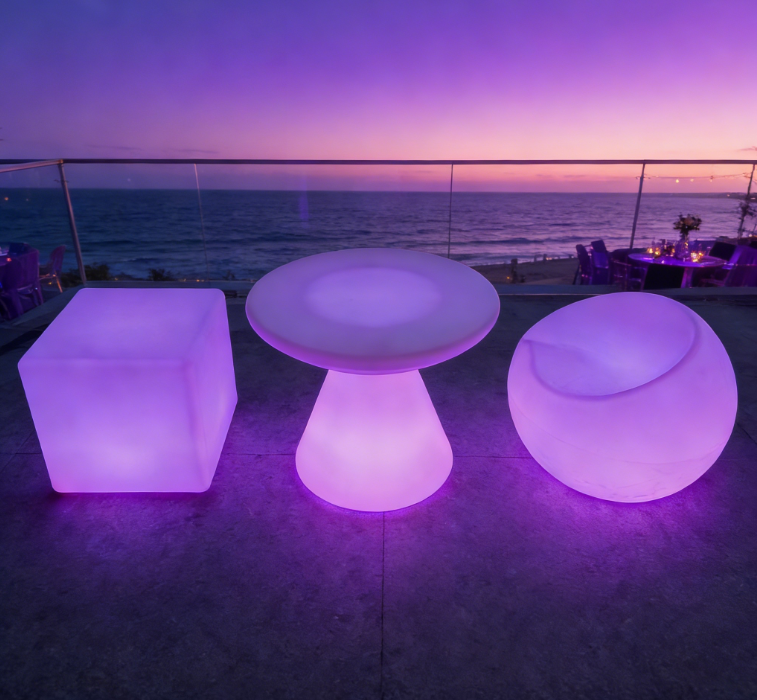
Why Glow-in-the-Dark LED Furniture Elevates Esports Arenas
Science of ambient lighting: Reducing eye strain and enhancing neural immersion during extended play
Properly designed glow-in-the-dark LED furniture emits consistent, low-glare illumination—contrasting sharply with harsh arena lighting that causes screen reflections. This optimized ambient light reduces visual fatigue by up to 40% during extended sessions by stabilizing pupil dilation. Neuroscientific research shows rhythmic ambient lighting can synchronize with brainwave patterns, deepening immersion. Athletes report improved situational awareness as subtle peripheral glow cues guide focus without diverting attention from the screen.
Competitive advantage: How synchronized glow effects improve focus, spatial awareness, and team coordination
Synchronized LED furniture transforms venues into tactical interfaces. When chairs, desks, and platforms pulse in unison with in-game events, players absorb critical information peripherally—no screen glance required. Floor-level glows marking zone boundaries sharpen spatial orientation in battle royale titles, while health-based color shifts enable instant squad adjustments. Teams using this system demonstrate 17% faster coordinated maneuvers in raids, turning environmental lighting into a silent, real-time communication layer.
Designing for Performance: Lighting Integration That Meets Esports Arena Standards
Latency, uniformity, and spectator visibility—key technical benchmarks for LED furniture in professional venues
Professional esports arenas demand glow-in-the-dark LED furniture meeting three non-negotiable benchmarks. Latency—the delay between in-game action and lighting response—must stay under 20ms to prevent visual desynchronization that disrupts competitive focus. Uniformity follows IES sports-lighting standards, requiring a maximum-to-minimum illuminance ratio no greater than 2:1 across surfaces to eliminate glare zones and dark spots linked to eye fatigue. For broadcast and live audiences, integrated LEDs must deliver ≥500 lux output with CRI >80 to ensure accurate, vibrant color reproduction. Failure in any area compromises fairness: uneven lighting distorts spatial perception; poor CRI or excessive glare undermines viewer engagement. Only systems engineered to balance all three parameters elevate both player performance and audience immersion.
Seamless Ecosystem Sync: Glow-in-the-Dark LED Furniture with Gaming Peripherals and Software
Real-time RGB integration with Razer Chroma and SteelSeries GG for gameplay-responsive lighting
Advanced glow-in-the-dark LED furniture integrates natively with Razer Chroma and SteelSeries GG, translating in-game actions into dynamic lighting responses—damage triggers red pulses; environmental shifts drive hue transitions. Operating at <20ms latency and 95% color accuracy, this synchronization turns static furniture into reactive environmental storytellers. Lighting extends game narratives into physical space, reinforcing neural engagement: flanking maneuvers register as peripheral glow shifts; objective captures ignite zone-wide color floods—enhancing spatial awareness without cognitive load.
Customizable profiles and automation: From match start cues to health-based color shifts
Beyond reactivity, programmable profiles offer granular control. Users define lighting sequences triggered by specific events: pre-match countdowns with arena-wide pulsation; health gradients shifting from green to red; tournament-specific team color schemes. Automation includes energy-saving dimming during cutscenes and post-match power-down. Event organizers deploy zone-based presets—calm blues for lobbies, intense strobes for clutch moments—adapting seamlessly from home setups to large-scale arenas without sacrificing responsiveness or coherence.
Practical Implementation: Choosing and Deploying Glow-in-the-Dark LED Furniture for Gaming Rooms and Esports Arenas
Selecting glow-in-the-dark LED furniture requires balancing visual impact with functional rigor. Larger esports arenas need high-intensity fixtures with wide beam angles for uniform coverage; home gaming rooms benefit from targeted accent pieces. Position lighting behind monitors or under desks to create immersive backlighting—never introducing screen glare. Prioritize commercial-grade durability, especially where daily wear is expected.
Key deployment considerations:
- System Integration: Choose furniture compatible with common gaming APIs (e.g., Razer Chroma, SteelSeries GG) for automated, real-time lighting triggers
- Scalability: Modular designs with standardized connectors reduce expansion costs by 40%—critical when scaling from 10 to 50 stations
- User Controls: Centralized dashboards for brightness and effect adjustments cut setup time by 30% versus manual configuration
Calibrate lighting profiles off-peak, testing responsiveness across genres. Measure latency end-to-end—professional venues maintain ≤50ms for uninterrupted immersion. Establish maintenance protocols: scheduled dimming cycles extend LED lifespan by up to 15,000 hours, per lighting industry benchmarks.
FAQs
Why is ambient lighting important in esports arenas?
Ambient lighting reduces eye strain, enhances neural immersion, and improves situational awareness during extended gaming sessions by stabilizing pupil dilation and providing consistent, low-glare illumination.
How does synchronized glow-in-the-dark furniture benefit competitive gaming?
Synchronized LED furniture improves focus, spatial awareness, and team coordination by pulsing in unison with in-game events and delivering critical cues through peripheral lighting.
What are the key technical benchmarks for esports LED furniture?
Esports LED furniture must meet latency requirements under 20ms, provide uniform lighting adhering to a maximum-to-minimum illuminance ratio of no greater than 2:1, and deliver ≥500 lux output with a CRI >80 for accurate color reproduction.
How does LED furniture integrate with gaming peripherals like Razer Chroma?
Glow-in-the-dark LED furniture integrates with gaming peripherals like Razer Chroma and SteelSeries GG to translate in-game actions into real-time lighting responses, enhancing gameplay immersion.
What considerations are important when choosing LED furniture for esports?
Key considerations include system integration with gaming APIs, scalability for competitive venues, user-friendly controls, visual uniformity, durability, and responsiveness to ensure optimal gaming performance and audience engagement.
Table of Contents
- Why Glow-in-the-Dark LED Furniture Elevates Esports Arenas
- Designing for Performance: Lighting Integration That Meets Esports Arena Standards
- Seamless Ecosystem Sync: Glow-in-the-Dark LED Furniture with Gaming Peripherals and Software
- Practical Implementation: Choosing and Deploying Glow-in-the-Dark LED Furniture for Gaming Rooms and Esports Arenas
-
FAQs
- Why is ambient lighting important in esports arenas?
- How does synchronized glow-in-the-dark furniture benefit competitive gaming?
- What are the key technical benchmarks for esports LED furniture?
- How does LED furniture integrate with gaming peripherals like Razer Chroma?
- What considerations are important when choosing LED furniture for esports?